On behalf of FICPI, Katsumori ISEKI attended the Korea Intellectual Property Association (KINPA) Annual Conference on 28 October 2026 at the Grand Walkerhill in Seoul. Katsumori is Chair of FICPI’s Study & Work Group on International Patent Matters, known as CET 3. With the rapid evolution of artificial intelligence (AI) serving as the main theme, the conference brought together IP experts, corporate IP professionals, and legal practitioners from around the world to discuss the latest trends and practical insights regarding structural changes in IP practice and organisation.
Key impressions
Throughout the conference, the discussions centred around two primary aspects: "Redefining the role of corporate IP departments amid the full-scale emergence of generative AI and AI agents" and "Rights protection and risk management in digital spaces and emerging technologies".
1. Transforming the role of IP departments (Driving AX)
As routine tasks such as prior art searches and standard drafting become increasingly automated by AI agents, IP professionals must shift their focus toward delivering higher value—such as strategic alignment with business goals, improving portfolio quality, and supporting executive decision-making.
2. Preparing for global disputes & regulations
Practical expertise was shared regarding cross-border litigation trends in Standard Essential Patents (SEPs) and FRAND obligations across key jurisdictions (US, Korea, Europe, and China), rising antitrust/competition law risks, and appropriate frameworks for protecting designs and copyrights associated with AI-generated output.
Session summaries and key highlights
Keynote dialogue: IP policy and the future of corporate IP
Representatives including the Minister of the Ministry of Intellectual Property (MOIP) and the President of the Korea Patent Attorneys Association discussed national IP protection/support policies and corporate IP investment strategies under intense global competition.
Session 1: Special theme: Transforming the role of IP organisations in the AI era
• LG Energy Solution presentation: shared organisational transformation processes and structures to transition IP operations from a traditional "support" role to a "strategic leadership" role within fast-evolving industries.
• AI workflows of foreign associates (Patsnap): demonstrated how foreign local associates leverage global IP databases and AI tools to streamline patent search and drafting workflows.
• Panel discussion (Samsung Electronics, LG Innotek, CJ CheilJedang, SHIN & KIM): addressed the provocative question, "Will corporate IP teams become obsolete in the era of AI agents?" The panel emphasised that human judgment, risk ownership, and strategic reporting to executive management remain indispensable, outlining future models for global partnerships
Session 2: IP-AX (AI transformation)
Theme: AX methodologies and foundational infrastructure for corporate IP management
• IP policy challenges in the AI era (MOIP): covered government administrative responses to generative AI and AI-assisted examination, highlighting upcoming policy issues.
• From models to agents (LG AI research): explored the technological evolution from Large Language Models (LLMs) to autonomous AI agents that break down and execute complex tasks, presenting a future vision for automated IP workflows.
• Panel discussion (Clarivate, LexisNexis, WIPS, wert intelligence, TOP Engineering): discussed concrete infrastructure requirements for implementing AX within corporate IP teams, including data security, data precision, and integration with existing IP management systems.
Session 3: Brand
Theme: Brand protection strategies and K-Brand initiatives in digital environments
• AI in trade mark distinctiveness assessment (KIIP): presented findings and technological limitations concerning the automated evaluation of trade mark registrability using AI.
• Brand creation & protection case studies (IICOMBINED, Wegofair, etc.): highlighted IP protection strategies for rapidly growing global brands and effective measures against tradedmark squatting and counterfeit goods in expanding digital/e-commerce environments.
Session 4: Design, copyright
Theme: Design & copyright protection for emerging technologies and AI outputs
• Protection paradigms for digital & emerging-tech designs (Jones Day): addressed legal issues and corporate strategies regarding UI/UX, metaverse assets, and AI-generated design protection.
• Global Generative AI copyright litigation (WilmerHale): analysed recent litigation trends and key legal considerations surrounding AI training data across the U.S. and Europe.
Session 5: IP creation
Theme: Deep-tech IP strategies & European Patent (EPO) practices
• Startup to 1 trillion KRW IPO success case (LivsMed): shared how a medical device deep-tech enterprise strategically built its IP portfolio from inception to achieve high valuation and a successful IPO.
• European patent securing strategies (Maiwald): offered practical insights for efficient filing and prosecution under the Unitary Patent system in Europe.
Session 6: IP dispute
Theme: Standard Essential Patents (SEPs), patent enforcement, and competition law risks
• FRAND obligations & SEP disputes (DLA Piper, KIM & CHANG): compared judicial trends and FRAND determination standards between Korea and the United States in high-tech and mobility sectors.
• Patent enforcement and antitrust risks (Global Expert Panel): discussed cross-border antitrust and competition law risks associated with enforcing patent rights across the U.S., Korea, Europe, and China.
Overall insights & reflections as an IP professional
Attending this conference provided two major takeaways from the perspective of an IP practitioner:
• High-dimensional value addition as the key to future survival:
It goes without saying that leveraging AI in intellectual property operations has become an absolute necessity. However, simply utilising AI is no longer a differentiator; the key to survival and future competitiveness lies in leveraging AI technology as a baseline to deliver higher-dimensional, strategic value to the organisation. We should transition foreign associate relationships beyond task delegation toward high-value global collaboration.
• Surging interest in IP across Korean industry:
Witnessing the remarkable growth and success of the KINPA Conference in recent years vividly reflected the expanding awareness, momentum, and commitment toward intellectual property across the entire industrial sector in Korea.
FICPI's view
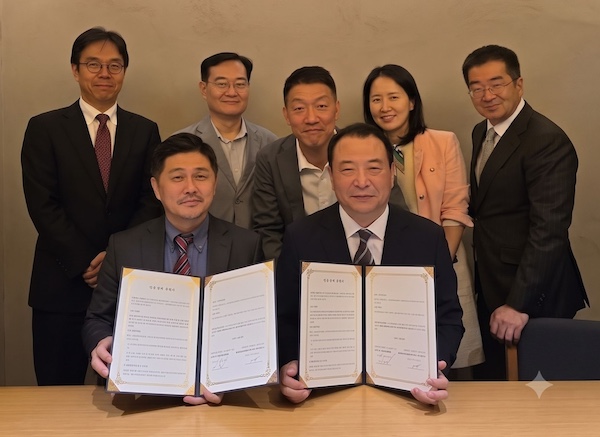
- On 28 September 2026, FICPI-Korea officially signed a Memorandum of Understanding (MOU) with the Korea Intellectual Property Association (KINPA). The MoU formalises high-level professional and academic exchanges, fostering meaningful dialogue and synergy between global IP practitioners and Korean industry leaders. The signing ceremony (photo below)was graced by key leaders from both organisations, including KINPA's President Min-Tae Kim, Secretary General Tae-Jun Suh, and Executive Director Ho-Gon Kim, alongside FICPI-Korea's President, Doohee LEE, Vice Presidents Kyung-Min Matthew Suh and Eunsun (Emma) Choi, and Secretary General JiHoon Joseph Hong.
- FICPI’s involvement at the KINPA Annual Conference reinforced its role in the international IP community. FICPI continues to champion the interests of independent IP attorneys and promote a strong, effective, and innovation-friendly intellectual property framework worldwide.