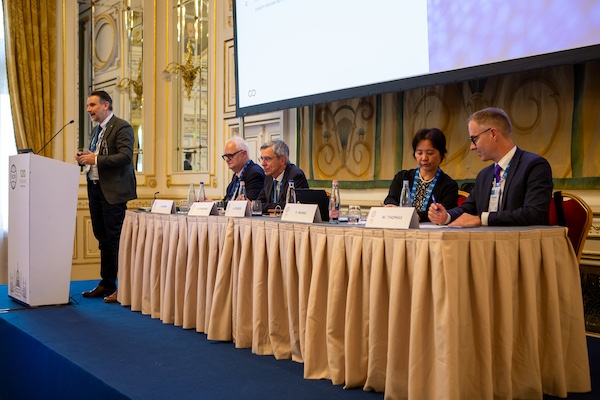
A cross-border patent dispute rarely announces itself as one. It begins with a product launch or a licensing approach, and the patent attorney is usually the first professional the client calls. The patent stream's opening session at FICPI's 23rd Open Forum in Budapest in September 2026 asked what happens next, bringing together four speakers who see it from very different places. A fictitious dispute ran through the afternoon: a Luxembourg licensor's standard-essential patent, validated in Germany, Spain and the UK, asserted against a Munich implementer manufacturing in Shenzhen.
Judge Klaus Grabinski, President of the UPC Court of Appeal, speaking personally, began by declining the session's own title. He does not care for "long-arm jurisdiction", which carries a certain bias, and set out to persuade us that it is simply how jurisdiction works in the EU. Infringement jurisdiction follows the place of infringement under Article 7(2) of the Brussels Regulation or the defendant's seat under Article 4, the principle being that a defendant may always be sued in its own courts. Validity is different: Article 24(4) reserves it to the state of grant, revocation being an act of sovereignty. So for a non-UPC EU state such as Spain the UPC has no jurisdiction over validity: following BSH and Kodak/Fujifilm the defendant is given a chance to bring a revocation action there, failing which an injunction may issue. For a non-EU EPC state such as the UK it does not apply at all, so the UPC may rule inter partes and enjoin on condition that the injunction falls away if a UK court later revokes. That condition, he emphasised, is comity.
Antony Craggs of Shoosmiths traced the English jurisprudence through four stages. Unwired Planet was the foundation: a court dealing with infringement of a UK standard-essential patent may determine the terms of a global FRAND licence. The anchor remains the UK patent and the UK remedy, the court asking not about foreign validity but what willing parties would agree, which for a multinational portfolio is likely to be global. He put this down to the breadth of the courts' declaratory jurisdiction and their seeing the question through the prism of contract rather than competition law. Then came acceleration, with FRAND trials heard first and expedited; rebalancing, as implementers began choosing England rather than waiting to be sued; and innovation, in the form of interim licence declarations. It is the last that has generated friction, with the UPC and Munich courts making anti-interim-licence orders and the English court responding in turn. The next phase, he submitted, should be less about whether an English court can determine global terms and more about how the English, UPC and Chinese courts coordinate.
Professor Yanfang Wang offered a structure that cuts through much of the confusion about China: two gates. The first is jurisdiction, claim-specific and fact-sensitive, with different connecting factors for infringement, antitrust and FRAND claims, and global terms requiring a cumulative and sufficiently close connection. The second is effectiveness: a court may give judgment, yet a foreign order may still strip it of practical value. She was clear about the limits. An injunction cannot create jurisdiction, conduct preservation exists only to protect an existing proceeding, and relief is the exception rather than the rule: refused in Lenovo v Nokia for want of a real and urgent risk, granted in Huawei v Netgear in favour of an SEP owner. China faces the same tension as everyone else, and the search for a workable boundary between one court's jurisdiction and another's is not a uniquely Chinese one.
Wolfram Thomas closed from the user's side, Qualcomm being both a major patent owner and, through its chips, a major implementer. The UPC promised quick and predictable judgments and has delivered them, but the intricacies under discussion may not help with either. A judgment, he observed, is where the work starts rather than ends: the parties must understand it and be able to operate under it. He illustrated the point with Onesta IP v BMW, in which Onesta asserted two US patents alongside a European patent in the Munich I Regional Court. BMW responded in Texas, where Judge Albright enjoined Onesta from pursuing the US-patent claims in Germany, holding that to do otherwise would eviscerate the US statutory scheme and deprive BMW of a jury trial. Reported as the first post-BSH German action asserting US patents, it shows one can never be sure another court will give way. He also pressed the importance of consent in cases where a court may be endeavouring to set FRAND terms, warning that a court restraining a party from suing to enforce its patent rights elsewhere goes beyond what that party agreed to in a FRAND undertaking. He also challenged the counting of patents to set rates, since, among other reasons, no court asks whether those counted are actually implemented in commercial settings to the end users’ benefit.
Thanks to our moderator and speakers:
Julian Crump, FICPI President of Honour and Partner at Abel + Imray, UK - Moderator
Panellists:
- Judge Dr. Klaus Grabinski, President of the Court of Appeal and chairperson of the Presidium of the Unified Patent Court
- Antony Craggs, Partner at Shoosmiths, UK
- Professor Wang Yanfang - Professor and Doctoral Supervisor at the School of Intellectual Property at East China University of Political Science and Law (ECUPL) in Shanghai, and a former judge of the Supreme People's Court of China
- Wolfram Thomas, Senior Director and Patent Counsel at the German subsidiary of Qualcomm and a member of Qualcomm's worldwide Intellectual Property Department
FICPI's view
Comity was the thread throughout. The four speakers came from different legal systems and different sides of the patent relationship, but all confronted the same question: how far a court's jurisdiction can reach, and how far it should reach when another court may have an equally legitimate claim to part of the dispute. There is no settled answer, and the increasingly international character of this litigation makes it unlikely that one jurisdiction will supply it alone.
That is what made the discussion one for FICPI. Independent IP attorneys are often the point at which the parts of an international dispute first come together, and advising the client requires an understanding of what one court can do and of what courts elsewhere may do in response. Bringing those perspectives into one room does not resolve the tensions, but it does make them easier to understand, to anticipate and to explain. The "long arm" may be a label Judge Grabinski would rather discard, but for FICPI members the wider view is the point.
Next steps
Save the date for FICPI's 24th Open Forum in Athens, 3-6 November 2027, where practice management topics will again be high on the agenda.