Basel, 1906. The problem facing patent attorneys was simple. Commerce was becoming international. Patent practice was not.
Inventors wanted protection beyond their home countries. Businesses needed trusted advisers abroad. Laws differed. Procedures differed. Professional rules differed. A client seeking rights in another country needed more than an address. They needed confidence that the person receiving the instruction understood the law, the deadline and the risk.
FICPI, the Fédération Internationale des Conseils en Propriété Intellectuelle or International Federation of Intellectual Property Attorneys, was founded to answer that need.
Article 2 of its statutes framed the purpose plainly: strengthening the professional bonds between IP attorneys in private practice, combining their efforts on reforms to conventions, laws and regulations, and dealing with questions affecting the profession.
That statement still feels current because the central problem has not gone away. It has changed form.
The unique attributes of the independent IP attorney
The world of 1906 was built around national patent and trade mark systems. Today's practitioners work with the PCT, regional patent systems, global brands, multinational portfolios and artificial intelligence. Yet the client's need remains recognisable: competent, independent professional advice from someone who understands both the legal system and the practical consequences of using it. That is FICPI's constant cause.
The independent attorney occupies a particular place in the IP system. The attorney is not the inventor, the company, the patent office or the government. The attorney stands between technical or commercial ambition and legal consequence, and that position carries duties. It requires judgement. It requires independence, qualities that have had to be defended in every generation.
Defending professional standards
In Rome in 1960, under President Arne Kolster, debate over freedom of establishment in the European Economic Community raised concerns about professional qualifications and the dilution of national standards. In Cannes in 1967, with René Jourdain now serving as President, the proposed Patent Cooperation Treaty prompted a related worry: would an international filing system reduce the role of national patent agents?
Seen from today, the anxiety may look misplaced. The PCT became indispensable. International filing became routine. But FICPI was asking the right question. If procedure becomes more centralised, who remains responsible for advising the client on the consequences in each country?
The same instinct shaped FICPI's later work on harmonisation. Through the 1960s and 1970s, FICPI's posture had been a cautious one, wary that supra-national systems would dilute national standards. At Edinburgh in 1981, under President Per-Urban Hjärne, that posture turned: FICPI urged WIPO and the European Patent Office to study the introduction of a grace period, shifting from scepticism to active advocacy for harmonised rules. The problem was practical: researchers and businesses were losing rights through premature disclosure under strict novelty rules. At Hilton Head in 1987, under President Camille Polus, FICPI went further, supporting a balanced harmonisation package built around a first-to-file system, on condition that it was paired with an international grace period.
That was not procedural neatness. It was the profession doing what it should do: asking whether reform would work for the people who use the system. FICPI has rarely opposed change as such. Its better instinct has been to ask what change does to applicants, rights holders and their advisers. Does it improve legal certainty? Does it preserve professional responsibility? Does it help the client make better decisions?
Independence is not a slogan
That thinking also lies behind FICPI's understanding of the "free profession". For FICPI, independence is not a slogan. It is the reason the profession exists. The independent practitioner advises clients as a professional, not as an arm of a government, a patent office or a single corporate employer. The adviser's primary responsibility is to the client, subject to ethical duties and conflicts rules.
That distinction explains why membership standards, professional qualifications and regulation have mattered so much to FICPI. They are not internal housekeeping.
They define the organisation's identity.
The point became especially clear in FICPI's 2005 work, under President Francis Ahner, on patent attorney services in the European Internal Market. Its four "Essential Safeguards" addressed a practical risk: rights holders needed a guaranteed route to a properly regulated attorney, and protection from providers who were not members of any regulated profession. The Host State Principle reflected the same balance, a patent attorney regulated at home could serve clients across borders, but only within the rules of the country where the work was done. Cross-border service mattered. So did professional standards and client protection.
Today's test is the impact of AI
The modern test is artificial intelligence. It is already being used in searching, drafting, translation, classification, examination and decision-making, and its role will grow. Some of that will be useful. Some of it will be unsettling. Much of it will be unavoidable.
FICPI's 2025 resolution on human-centric use of AI in the IP system, adopted at the Naples World Congress under President Roberto Pistolesi, at which Elia Sugrañes was elected as his successor, accepts that AI has a place, but insists that substantive decisions affecting rights remain subject to at least one competent human examiner or judge. That is not a defensive position. It is a professional one. AI can assist an attorney. It cannot owe duties to a client. It cannot understand commercial context the way a professional adviser must, and it cannot explain why a clever procedural shortcut may create unacceptable risk.
Independent professional advice matters
Across 120 years, the tools have changed, the filing routes have changed, the institutions have changed. Leadership has passed through many hands: Malcolm Royal handed the presidency to Francis Ahner as the centenary approached, and the Federation is now led by its present Bureau under Elia Sugrañes.
The question has remained the same. Who stands beside the client? FICPI's answer has been consistent since Basel: independent professional advice matters.
This article is part 1 in a 3-part series celebrating 120 years of FICPI.
Read the second article: The world gets smaller: building the FICPI family over 120 years
The final part will be published over the coming month.
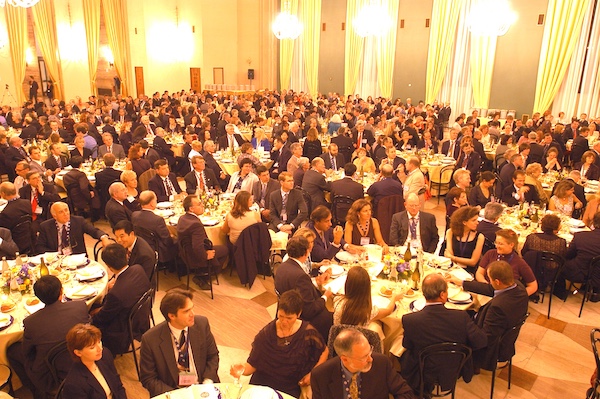
Venice Open Forum 2004
FICPI's view
Today FICPI continues to champion the interests of independent IP attorneys and promote a strong, effective, and innovation-friendly intellectual property framework worldwide. FICPI uniquely combines education and advocacy on topics around patents and trade marks, with a focus on developing the professional excellence of its individual members.
FICPI Fora, Congresses, committees and meetings are opportunities to gather insights from the international IP attorney community on any issue, whether it be practice-related or topics of patent and trade mark law. FICPI members help drive the IP community forwards by developing opinions and positions, attending meetings with IP organisations and Offices and working actively with FICPI members.
Next steps
Join us at the 23rd FICPI Open Forum in Budapest (16-19 September 2026): https://ficpi.org/ficpi2026
Consider becoming involved with FICPI's working parties and Committees, click here to find out more
AI was used to assist in researching the FICPI archives