This article is part 2 in a 3-part series celebrating 120 years of FICPI. The final part will be published over the coming month.
Every experienced patent or trade mark attorney knows the feeling. A client calls with a problem in a country where you do not practise. The matter is urgent. The deadline is real. The first question is not theoretical: who do I trust?
That question explains a great deal about FICPI.
When the Federation was founded in Basel in 1906, eight countries stood at the start of the story: Belgium, Denmark, Finland, France, Italy, Norway, Sweden and Switzerland. It was a European beginning, shaped by the professional world of its time. But the logic of the organisation was international from the start. FICPI existed because independent practitioners needed one another, professional relationships across borders, shared standards, a forum in which the profession could speak beyond national systems.
Collaboration across continents
The Federation's later growth shows how quickly that need expanded. Spain joined in 1967. Germany followed in 1968. South Africa in 1973. The United Kingdom in 1974. Argentina and Chile in 1975. Colombia in 1976. Japan in 1977. Brazil and Portugal in 1978. The United States joined in 1981 and Canada in 1982.
As a list, those dates are dry. As professional history, they are telling. They show IP practice becoming global, clients thinking internationally, and a profession moving beyond familiar neighbouring jurisdictions into a world where protection, enforcement and advice had to be coordinated across continents.
For much of the twentieth century, international practice depended on relationships built slowly. A foreign associate was not a search result. A referral was not an automated workflow. Trust came from repeated dealings, congresses, committee work, correspondence, reputation and memory. That is why the expression "FICPI family" matters.
It can sound sentimental to outsiders. In practice, it describes something central to the business of independent IP practice. Attorneys rely on colleagues in other countries to protect their clients' interests, and that reliance is professional as much as personal. When something goes wrong abroad, the client still looks to the adviser at home.
Continuity and recognition
FICPI helped build the human infrastructure for that work. Its congresses and meetings were not only occasions for speeches and resolutions. They were places where practitioners learned who could be trusted, met colleagues whose names later appeared on urgent instructions, and argued together, in commissions, over procedure, harmonisation, professional standards and policy. Over time, professional confidence became personal familiarity. That is not nostalgia. It is still how international private practice works.
Growth also required structure. A small professional circle can function through personal knowledge. A global federation cannot. As FICPI expanded, it had to develop admissions procedures, membership categories, commissions, governance rules and, eventually, a permanent Secretariat. Those developments may sound administrative, but they were necessary: the Federation was no longer a small European grouping. It had become a global professional community.
National courts eventually recognised as much. In 1995, Germany's Federal Court of Justice ruled that the German Chamber of Patent Attorneys could lawfully subscribe its entire membership to FICPI en masse, holding that global IP integration gave national bodies a legitimate interest in international representation through an independent federation. That is an unusual thing for a court to say about a professional network. It is also exactly the point: FICPI's relationships were not a convenience for individual members. They were infrastructure a whole profession could rely on.
The work was carried forward by successive generations of members and leaders. In 2003, at the Berlin Congress, Malcolm Royal handed the presidency to Francis Ahner as FICPI approached its centenary, a far more international organisation than its founders could have imagined.
That continuity matters. The Federation did not become global simply by admitting more countries. It became global because people invested time in the relationships, procedures and habits that made international cooperation reliable.
The outside world was changing at the same time. The Patent Cooperation Treaty made international filing more routine. Regional systems became central to practice. Harmonisation debates occupied governments and professional bodies. Clients increasingly thought about markets, brands and technologies on a global scale from the outset. None of that made independent attorneys less dependent on one another. It made trusted relationships more valuable.
Trusted and experienced IP professionals
Modern communication has changed the mechanics, but not the human problem. An email can reach another country instantly. It cannot tell you whether the recipient will give clear advice. A directory can identify a firm. It cannot create confidence. A platform can transmit instructions. It cannot replace judgement.
That is why the FICPI family remains a serious concept rather than an anniversary slogan. It reflects the practical truth that international IP rights are protected by people who trust one another enough to act for clients across borders.
The founders in Basel would not recognise today's IP system. They would be astonished by its scale, its technology and its procedural complexity. They would immediately recognise the importance of knowing whom to call in another country.
This article is part 2 in a 3-part series celebrating 120 years of FICPI.
Read part 1: 120 years of the independent IP Attorney: FICPI's constant cause
The final part will be published over the coming month.
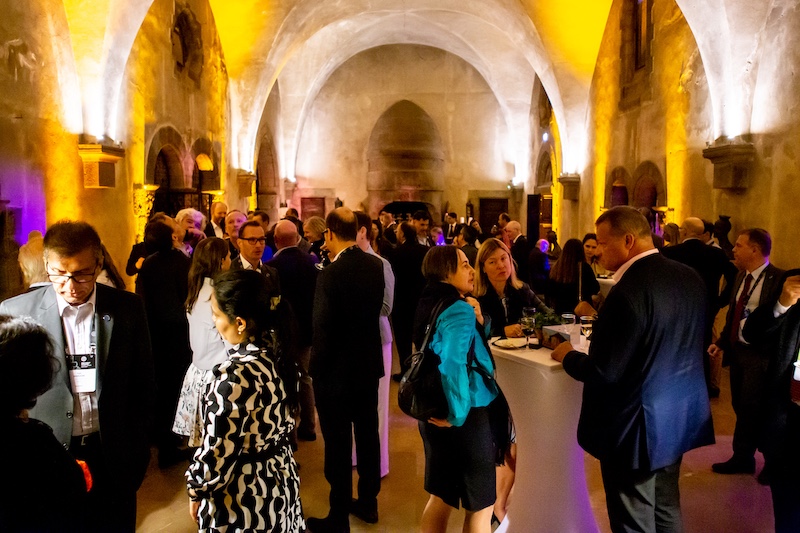
Cannes World Congress 2022
FICPI's view
Today FICPI continues to champion the interests of independent IP attorneys and promote a strong, effective, and innovation-friendly intellectual property framework worldwide. FICPI uniquely combines education and advocacy on topics around patents and trade marks, with a focus on developing the professional excellence of its individual members.
FICPI Fora, Congresses, committees and meetings are opportunities to gather insights from the international IP attorney community on any issue, whether it be practice-related or topics of patent and trade mark law. FICPI members help drive the IP community forwards by developing opinions and positions, attending meetings with IP organisations and Offices and working actively with FICPI members.
Next steps
Join us at the 23rd FICPI Open Forum in Budapest (16-19 September 2026): https://ficpi.org/ficpi2026
Consider becoming involved with FICPI's working parties and Committees, click here to find out more
AI was used to assist in researching the FICPI archives