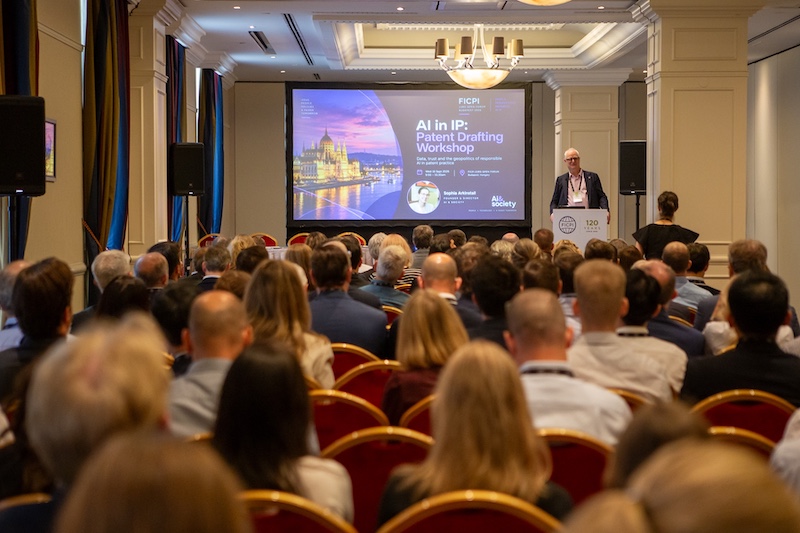
Ask a room of patent attorneys what AI brings to mind and the answers come quickly: efficiency, productivity, time saved. When Sophia Arkinstall put the question at FICPI's inaugural AI Patent Drafting Masterclass in Budapest on 16 September 2026, the responses also included unpredictability, game changing and, from one delegate, catastrophe. Her session, "Data trust and the geopolitics of responsible AI in patents", opened a day of tool-provider presentations and drafting workshops.
Sophia's central message took five words: "Every prompt is a disclosure."
Information entered into an AI system does not disappear into an abstract cloud. It goes to someone else's computer, on a rack in a data centre that might be in Singapore, Frankfurt or Virginia, and data on a US server sits under US law rather than the law of wherever attorney and client happen to be.
For independent attorneys this is not abstract. The work involves unpublished inventions, commercially sensitive plans and information shared in confidence with colleagues abroad. Rule 5 of FICPI's Code of Conduct binds each member not to disclose information received in confidence, and Rule 3 makes each member responsible for the observation of the Code in his office.
Sophia is Founder and Director of AI & Society and came to this from outside the IP profession, with a background in health science, business and property, and a focus on AI, society and place. Her proposition: Artificial Intelligence is centralised, but it is shaped by where it operates, and it always operates in jurisdictions.
She described a group of Australian independent schools whose large Microsoft contract gave them a working relationship with the provider. Knowing where their data was meant to be held, they were notified of a proposed change and worked with Microsoft to keep their P–12 data in Australia: data about young people, which they wanted kept within their own jurisdiction. Data location, Sophia said, is a contractual question to settle when a service is chosen and revisit afterwards, because a provider may change its arrangements without telling you.
Trust is not uniform either. She cited research by KPMG with the University of Melbourne finding 46% of people globally willing to trust AI systems, roughly 60% in emerging economies against 40% in advanced ones, with Europeans more sceptical. Regulation varies along the same lines: the EU is building risk-tiered rules, the United States is coordinating and innovating, Australia has issued voluntary guidance, and China is governing and controlling. ChatGPT and Claude were unavailable to her in Hong Kong.
Sophia’s conclusion was direct: "There is no global standard on AI at all at the moment."
The client may be in one jurisdiction, the attorney in another, the provider in a third and the data in a fourth, and the colleague you instruct may work to a different regulatory baseline. When we work across jurisdictions, she said, understandings differ, so clarity cannot be assumed.
Bias, according to Sophia’s account, is less about discriminatory output than about what the training data leaves out. Citing Oxford Internet Institute research, she noted that close to 80% of internet domains are registered in Europe or North America, and around half of websites are in English, and asked which perspectives and cultures are therefore missing from the answer.
Identifying responsible AI use
Sophia’s test for responsible use has five parts:
- Safety: can I safely share or enter this information?
- Suitability: am I using an approved tool, at an appropriate stage of the work?
- Source: can I identify and verify where the information came from?
- Scrutinise: have I independently checked the output?
- Sign off: is a human prepared to take responsibility for the result?
On the topic of ‘sourcing’, she pointed to retrieval augmented generation, which ties an answer to particular material in a defined collection of trusted documents. On the subject of ‘signing off’, she drew a distinction worth keeping, between a human in the loop and the human in the lead.
Two scenarios tested it. In the first, a client hands over confidential project information including a budget, development costs and supplier details for generative AI to summarise. The room rated legal risk highest and returned repeatedly to one prerequisite: client consent. In the second, AI supplies apparently relevant prior art with publication numbers and summaries. Participants raised verifying citations within the documents, a supplementary manual search, the provider's data-processing terms, and the risk that the prompt itself discloses.
Her closing advice was short. Understand what you are sharing. Verify independently. Know where your data is processed. Make sure everyone in the firm does the same, because others in the firm also have access to these systems, and Rule 3 puts the observation of the Code in the office on the member. And answer the question countries have already answered for themselves: what is your firm's AI strategy?
For FICPI members, the question runs beyond any one firm. Our work depends on trusted relationships between independent attorneys in different countries, and responsible AI use belongs in the conversation between them: whether client information may be entered into an AI system at all, which tools are approved, where processing happens, and who signs off. The technology is centralised. The law, the professional obligations and the client's expectations are not.
FICPI's view
FICPI is working to make sure that the independent IP attorney profession remains fit for purpose by adapting to the present and the future. AI is a critical part of that, as reflected in the development of the FICPI AI Patent Drafting Masterclass this year. As a global community, built on trusted relationships, FICPI helps strengthen the practice of the independent IP community. FICPI Fora, Congresses, committees and meetings are opportunities to gather insights from the international IP attorney community on any issue, whether it be practice-related or topics of patent and trade mark law, including AI where speakers from around the world shared insights on the topic at our 23rd Open Forum in Budapest in September 2026.
Next steps
- Save the date for FICPI's 24th Open Forum in Athens, 3-6 November 2027, where AI topics will again be high on the agenda.
- Are you interested in working on AI topics and issues? Please contact the PMC Technology group: [email protected]