Artificial Intelligence has clearly moved from the margins to the mainstream of IP practice. What was once framed as experimentation or innovation is now widely understood as infrastructure.
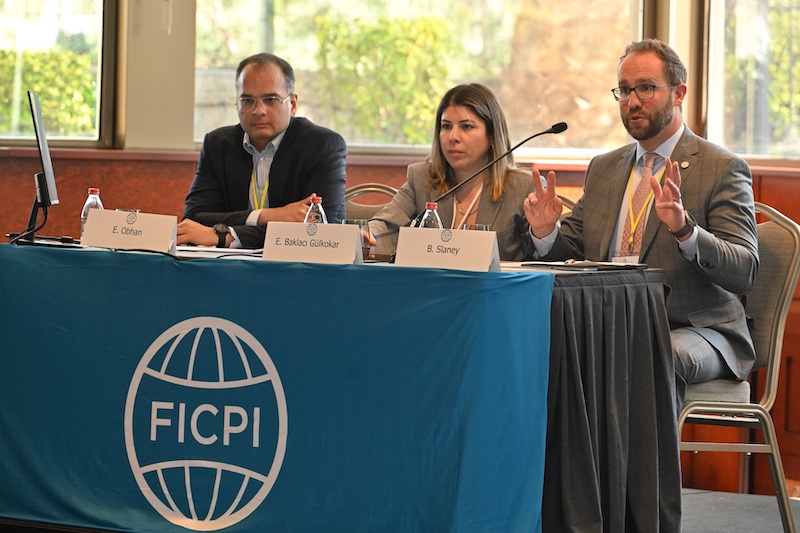
The 20 April 2026 'FICPI-FICPI Türkiye Seminar' included a thought-provoking session reflecting on AI use in the IP profession.
The speakers provided a broad and practical overview of current and expected uses of AI in IP practices, featuring Ezgi Baklacı Gülkokar from Moroğlu Arseven in Türkiye and Essenese Obhan, FICPI Academy President from Obhan Mason in India, with moderator Brett Slaney, CET Executive Vice President and from CPST IP in Canada. They shared personal experiences, what has worked, what has not, and plans for continuing to adopt AI into IP workflows.
AI tools are already embedded in day to day operations, across patent and trade mark prosecution, portfolio management, searching, drafting, docketing, and administrative workflows,
The real question facing IP practitioners today is no longer whether AI will be used, but how it can be integrated responsibly without undermining professional judgement, ethics, or strategic value.
A central theme emerging from this session was inevitability. IP work, by its nature, lends itself to automation: it is structured, rules based, document heavy, and repetitive in many of its execution level tasks. AI systems excel in precisely these environments. As competitors embrace AI to accelerate turnaround times and compress costs, firms that resist adoption entirely risk becoming uncompetitive, not because their legal reasoning is inferior, but because they cannot meet baseline expectations of efficiency and responsiveness.
At the same time, the growing maturity of AI has clarified an essential distinction between execution and strategy. AI is an outstanding tool for searching large datasets, summarising correspondence, monitoring deadlines, generating first drafts, and handling administrative tasks at scale. It is currently far less reliable, and should be used cautiously, when used to apply legal reasoning, claim strategy, ethical judgment, or advocacy.
The most sustainable model is therefore felt to be, not AI driven practice, but AI assisted practice, where technology accelerates execution, so that professionals can focus their time on higher value judgment work. This is consistent with one of FICPI’s recent resolutions on “Human-centric use of AI in the IP system”.
Rearticulating the value of IP attorneys
This shift to AI-assisted practice, inevitably places pressure on traditional business models and has even seen the rise of new “AI-Native” IP firms, built from ground up with AI at core of its operations. When tasks that once took hours can now be completed in minutes, billing structures built solely on time spent become difficult to defend. Clients increasingly expect faster delivery, predictable pricing, and transparency around the use of AI. In response, IP firms are being pushed to rethink how they articulate value, not in terms of effort, but in terms of expertise, risk management, and strategic insight. AI does not eliminate the need for experienced professionals; instead, it raises the premium on those professionals’ judgement.
However, the benefits of AI come with material risks. One of the most persistent challenges remains hallucination: the generation of plausible sounding but incorrect facts, citations, or technical details. In patent drafting, this can manifest as invented features, over generalised language, or inconsistencies that jeopardise validity or enforceability. In legal research, hallucinations can amount to professional misconduct if not detected. For this reason, one principle is universally emphasised: no AI generated output should leave a firm without human review and accountability.
AI’s promise, and perils…
Effective adoption of AI is as much an organisational challenge as a technological one. Successful firms invest not just in tools, but in structured workflows, templates, drafting standards, and training programmes that teach practitioners how to use AI critically rather than passively. Engagement letters and client communications increasingly address AI explicitly, recognising that some clients welcome its use while others restrict or prohibit it. Transparency is essential; the conversation should happen before expectations are set by default.
Patent drafting provides a particularly clear illustration of both promise and peril. AI can dramatically accelerate the preparation of specifications and claims but only when guided by a human defined strategy. Best practice increasingly involves drafting claims and defining scope without AI to avoid anchoring bias, then using AI selectively for expansion, refinement, and consistency checking. Notably, AI often shifts the burden of work rather than eliminating it: time saved in drafting is frequently reallocated to deeper and more careful review.
Looking beyond individual firms, the impact of AI is being felt across the entire IP ecosystem. IP Offices are deploying AI in searching, classification, translation, and even office action generation, while emphasising that substantive decisions should remain human made. Clients are reassessing their relationships with outside counsel. The profession itself faces unresolved questions about training, career paths, and long term capacity if AI replaces traditional entry level work.
The common thread across all these changes is the need for a human centric approach. AI can be a powerful tool, but it is not a substitute for professional responsibility. The practitioners who will thrive are those who embrace AI thoughtfully, using it to eliminate drudgery, sharpen execution, and expand access, while preserving the judgment, ethics, and creativity that define the IP profession.
The Seminar was organised jointly by FICPI and FICPI-Türkiye.
FICPI’s view
Membership of FICPI makes IP attorneys more effective through its dual focus on legal and professional excellence. FICPI is working to make sure that the independent IP attorney profession remains fit for purpose by adapting to the present and the future, with adapting to new challenges such as AI an important part of that.
Next steps
- The new FICPI AI Patent Drafting Masterclass, will be held in person in Budapest on Wednesday 16 September 2026, immediately preceding the 23rd FICPI Open Forum. This intensive full day Masterclass combines an online preparatory phase with a structured in-person workshop – places are limited. Find out more at: https://ficpi.org/ficpi-ai-patent-drafting-masterclass-2026
- The FICPI Open Forum is open to any interested party from the IP community. Running from 16-19 September in Budapest, our Friday plenary session, AI in IP: the truth, the whole truth and nothing but the truth, will be sure to continue your interest in AI. The session will try to cut through the hype and the horror stories to give IP practitioners a clear, candid understanding of what modern large language models (LLMs) are and are not, how they actually work, and how data is handled when you use them. Book now at: https://ficpi.org/ficpi2026
- Read WIPO’s Index of AI Initiatives in IP Offices and the EUIPO’s manifesto on a responsible approach to AI.